
Who Is George Soros?
George Soros is one of the most famous investors in financial history. He became widely known for his short position against the British pound in 1992 — a trade that earned him more than $1 billion in a single day and led to him being called “The Man Who Broke the Bank of England.”
Unlike many traders who rely purely on technical analysis, Soros built his thinking around macroeconomics, crowd psychology, and especially the theory of Reflexivity — the concept that became his signature.
1. Markets Are Not Perfectly Efficient
Traditional financial theory suggests that markets always reflect all available information and are priced rationally.
George Soros disagreed.
According to him, markets are created by people — and people are always influenced by emotions, biases, fear, and greed. As a result, prices frequently diverge from intrinsic value.
He once argued:
“Markets are always biased in one way or another.”
This creates opportunities for those capable of recognizing these distortions.
Key Lessons:
- Never assume the current price is automatically “correct.”
- Always ask: What is the market overlooking?
- Price and reality do not always move together.
2. The Crowd Is Often Wrong at Extremes
Soros believed:
When the majority becomes extremely optimistic or extremely pessimistic, that is often the most dangerous moment.
At the top:
- Positive news appears everywhere.
- Everyone believes prices will continue rising.
At the bottom:
- Negative news dominates.
- People believe the market will never recover.
Yet those moments often carry the highest probability of reversal.
He did not blindly trade against trends; instead, he looked for situations where the crowd had gone too far.
Key Lessons:
- Don’t FOMO when everyone is euphoric.
- Don’t panic sell during fear.
- Emotional extremes often create major opportunities.
3. Bet Big When Probability Is Extremely High
One of Soros’ famous quotes:
“It’s not whether you’re right or wrong, but how much money you make when you’re right.”
He did not try to trade constantly.
Instead:
- Wait for truly significant opportunities.
- When probability and conditions align → increase position size.
This mindset differs from most retail traders:
- It’s not about trading more.
- It’s about trading less but trading better.
Key Lessons:
- Preserve capital when uncertainty is high.
- Scale up when the edge is obvious.
- Quality matters more than quantity.
4. Reflexivity – Markets Can Change Reality
This is George Soros’ most famous philosophy.
Conventional thinking says:
Economy → influences markets
But Soros argued:
Markets ↔ Economy
Rising prices can:
- Increase investor confidence.
- Make fundraising easier for businesses.
- Stimulate actual economic growth.
Falling prices can:
- Create fear.
- Reduce investment.
- Deepen economic slowdowns.
This is known as the reflexive feedback loop.
Example:
- Asset prices rise → confidence increases → capital flows increase → prices rise further.
- Prices fall → sentiment worsens → selling intensifies → prices decline further.
Key Lessons:
- Prices do not merely reflect reality.
- Prices can also create reality.
Applying George Soros’ Philosophy Today
1. Macro Trading
This is the trading style most closely associated with Soros.
Traders monitor:
- Interest rate policies
- Global capital flows
- Inflation
- Economic cycles
- Monetary policy
The objective is to identify where markets are mispricing the future.
Examples:
- A currency becoming overvalued.
- Stock markets growing faster than the real economy.
2. Bitcoin Cycle Trading
Bitcoin is a strong example of Reflexivity.
The cycle often looks like this:
Price rises
→ Media coverage increases
→ New investors join
→ Liquidity expands
→ Prices accelerate
Then:
Price falls
→ Fear spreads
→ Selling pressure increases
→ Prices decline further
Soros-style traders often monitor:
- Capital flows
- Market sentiment
- Leverage
- Community enthusiasm
3. Forex Trading
Foreign exchange markets are where Soros’ thinking shines most.
Key factors include:
- Interest rate differentials
- Central bank policies
- International capital flows
- Market expectations
The goal:
Not to predict every candle.
But to identify moments when markets are making large-scale pricing mistakes.
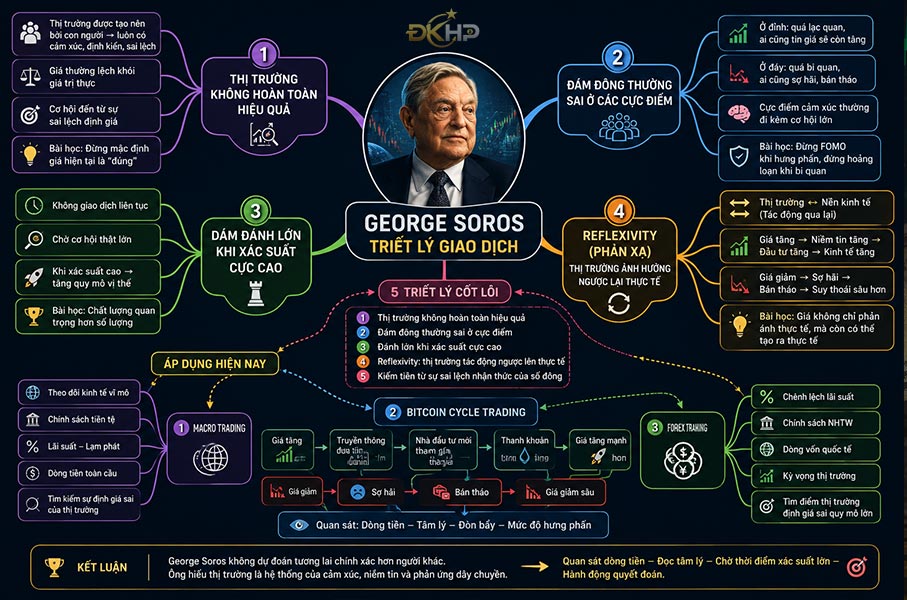
Summary: George Soros’ 5 Core Principles
- Markets are not perfectly efficient.
- Crowds are often wrong at extremes.
- Bet big when probability is exceptionally high.
- Reflexivity: markets influence reality.
- Profit from collective misperception.
Conclusion
George Soros did not become famous because he predicted the future more accurately than others.
He became famous because he understood that markets are systems driven by emotions, beliefs, and feedback loops.
In modern Crypto, Forex, and Macro investing, this philosophy remains highly relevant:
Observe capital flows – read market psychology – wait for high-probability moments – and act decisively.