

Who Is Ed Seykota?
Ed Seykota is one of the most successful and influential traders in the history of financial markets. He is widely recognized as a pioneer in applying computers to trading during the 1970s and as one of the most prominent representatives of the Trend Following trading philosophy.
Ed Seykota gained worldwide recognition after being featured in Jack D. Schwager’s classic book Market Wizards. In the book, he was credited with turning a trading account into thousands of times its original value over just a little more than a decade through strict adherence to a trend-following trading system.
Today, Seykota’s ideas continue to be widely applied across Forex, stocks, commodities, cryptocurrencies, and modern algorithmic trading systems.

The 5 Core Trading Philosophies of Ed Seykota
1. Follow Long-Term Trends
Ed Seykota believed that big money is not made by predicting the market but by capturing major trends.
He is famous for the quote:
“The trend is your friend.”
Instead of trying to pick bottoms or tops, Seykota focused on entering once a trend was established and holding positions until the trend ended.
Key Lessons:
-
Don’t try to predict the market.
-
Trade with the flow of money.
-
Be patient and let winning trades run.
2. Money Management Is More Important Than Entry Timing
According to Seykota, a great entry cannot save a poor money management system.
He always prioritized:
-
Position sizing
-
Risk management
-
Stop-loss placement
For Seykota, protecting capital was always more important than pursuing profits.
Key Lesson:
Without capital, a trader has no opportunity to continue trading.
3. The Market Is Always Right
One of Ed Seykota’s most famous beliefs is:
“The market is always right.”
The market does not care what traders think.
When prices move against expectations, Seykota would quickly accept being wrong and exit the trade rather than argue with the market.
Key Lessons:
-
Don’t try to prove yourself right.
-
Accept mistakes quickly.
-
Always respect price action.
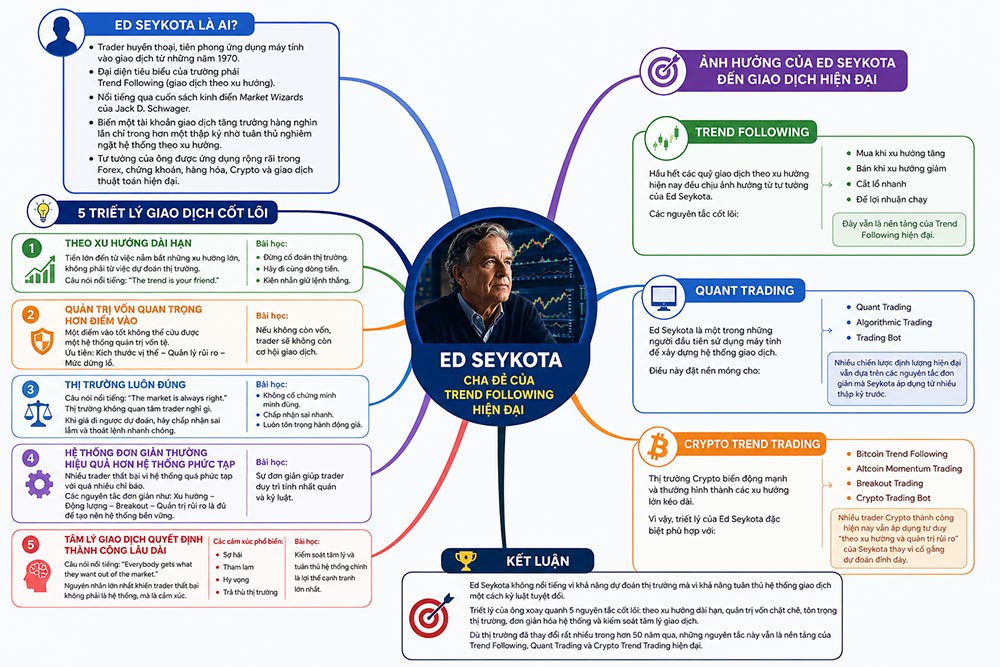
4. Simple Systems Often Outperform Complex Systems
Ed Seykota was a strong advocate of simple trading systems.
He believed many traders fail because they attempt to create overly complicated systems filled with dozens of indicators.
Meanwhile, simple concepts such as:
-
Trend
-
Momentum
-
Breakouts
-
Risk management
are often enough to build a sustainable trading system.
Key Lesson:
Simplicity helps traders maintain consistency and discipline.
5. Trading Psychology Determines Long-Term Success
According to Seykota:
“Everybody gets what they want out of the market.”
He believed that the biggest reason traders fail is not their trading system, but their emotions.
Common emotional challenges include:
-
Fear
-
Greed
-
Hope
-
Revenge trading
Traders can only achieve long-term success by mastering their psychology and consistently following their trading plan.
Key Lesson:
Strong trading psychology is one of the greatest competitive advantages a trader can have.
Ed Seykota’s Influence on Modern Trading
Trend Following
Most modern trend-following funds have been influenced by Ed Seykota’s principles.
Core concepts such as:
-
Buying in uptrends
-
Selling in downtrends
-
Cutting losses quickly
-
Letting profits run
remain the foundation of modern trend-following strategies.
Quant Trading
Ed Seykota was among the first traders to use computers to build trading systems.
His work laid the foundation for:
-
Quantitative Trading
-
Algorithmic Trading
-
Trading Bots
Many modern quantitative strategies still rely on the simple principles that Seykota applied decades ago.
Crypto Trend Trading
The cryptocurrency market is highly volatile and often experiences large, long-lasting trends.
As a result, Seykota’s philosophy is particularly well-suited for:
-
Bitcoin Trend Following
-
Altcoin Momentum Trading
-
Breakout Trading
-
Crypto Trading Bots
Many successful crypto traders today continue to apply Seykota’s principles of following trends and managing risk rather than trying to predict market tops and bottoms.
Conclusion
Ed Seykota became a trading legend not because of his ability to predict markets, but because of his unwavering discipline in following a trading system.
His philosophy revolves around five core principles: following long-term trends, managing risk and capital effectively, respecting the market, keeping trading systems simple, and mastering trading psychology.
Although financial markets have changed dramatically over the past 50 years, these principles remain the foundation of modern Trend Following, Quant Trading, and Crypto Trend Trading strategies.