

Who Is Richard Dennis?
Richard Dennis is one of the most legendary traders in the history of the financial markets. He became known as the “Prince of the Pit” due to his extraordinary success in the Chicago futures markets.
What makes Richard Dennis remarkable is not only his ability to turn a few thousand dollars into hundreds of millions but also a famous trading experiment known as the Turtle Traders.
The experiment sought to answer a question that had been debated for years:
Are great traders born, or can they be trained?
Dennis believed that traders could be trained, much like turtles raised on Asian turtle farms. He selected individuals with no trading experience, taught them a specific trading system, and transformed them into successful traders.
The results completely changed the investment world’s perception of systematic trading.

The Story of the Turtle Traders
In 1983, Richard Dennis and his partner William Eckhardt made a famous bet.
- Dennis believed that traders could be trained.
- Eckhardt believed that successful trading depended on innate talent.
To prove his point, Dennis recruited trainees from across the United States.
Thousands of applications were submitted.
After a rigorous selection process, only a small group was chosen.
These individuals came from a wide variety of backgrounds:
- Accountants
- Engineers
- Insurance professionals
- Students
- Professional gamblers
After several weeks of training, they were entrusted with managing millions of dollars in trading capital.
This group later became known as the Turtle Traders.
The results were impressive. Many of the trainees went on to earn tens of millions of dollars and became well-known fund managers.
This demonstrated that:
A sound trading system can be learned and successfully applied by ordinary people.
Richard Dennis’s Trading Philosophy
1. Great Traders Can Be Trained
This is Richard Dennis’s most famous philosophy.
He did not believe that trading success was an inborn talent.
According to Dennis:
Success in trading comes from learning the right rules and executing them consistently.
He once said:
“I always say you could publish my trading rules in the newspaper and no one would follow them.”
The meaning behind this statement is simple:
- Most traders already know what they should do.
- Very few have the discipline to actually do it.
Dennis believed that trading skills can be taught just like the skills required to become:
- A doctor
- A lawyer
- A pilot
- An engineer
With the right methodology and enough practice, anyone can become a profitable trader.
2. Systems Matter More Than Emotions
Richard Dennis was a pioneer of systematic trading.
He did not believe in:
- Intuition
- Predictions
- Rumors
- Market feelings
Instead, every trading decision should be based on objective rules.
For Dennis:
The trading system should make the decisions, not the trader.
When a signal appears:
- Enter the trade
- Place the stop loss
- Manage the position
Everything should be defined in advance.
This approach eliminates:
- Fear
- Greed
- Hope
- FOMO (Fear of Missing Out)
These emotions are responsible for most trading losses.
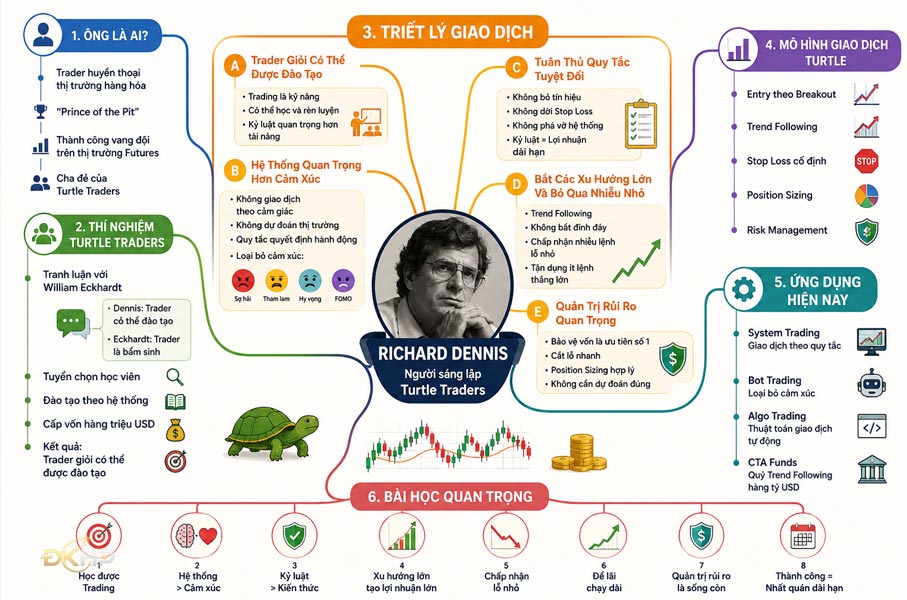
3. Follow the Rules Without Exception
Richard Dennis believed:
Even the best trading system will fail if its rules are not followed.
He observed many traders:
- Ignoring valid entry signals
- Moving stop losses
- Taking profits too early
- Holding losing positions for too long
All of these actions destroy the statistical edge of a trading system.
According to Dennis:
A trader should not be judged by a single trade.
Instead, performance should be measured over:
- Hundreds of trades
- Thousands of trades
Long-term profitability only emerges when rules are executed consistently.
4. Capture Big Trends and Ignore Small Noise
The Turtle Traders became famous for their Trend Following strategy.
They did not attempt to:
- Pick market bottoms
- Pick market tops
- Predict reversals
Instead:
They waited for trends to develop and then followed them.
Dennis’s philosophy was straightforward:
- Accept many small losses.
- Wait for a few very large winners.
For example:
- 10 losing trades × 1%
- 1 winning trade +20%
The overall result is still highly profitable.
Dennis understood that:
Most annual profits often come from only a handful of major trend-following trades.
Therefore, he focused on:
- Letting winners run
- Ignoring short-term market fluctuations
5. Risk Management Is More Important Than Prediction
One of the greatest lessons from the Turtle Traders experiment is:
No one knows where the market is going next.
Even the best traders can be wrong repeatedly.
As a result, Dennis focused on:
- Controlling losses
- Preserving capital
- Optimizing the Risk/Reward ratio
He believed that:
If risk is properly controlled, profits will naturally follow when major trends emerge.
Applying Richard Dennis’s Philosophy Today
More than 40 years later, Richard Dennis’s principles remain the foundation of many professional traders and investment funds around the world.
1. System Trading
System Trading is the direct descendant of the Turtle Traders philosophy.
Every element is clearly defined:
- Entry conditions
- Exit conditions
- Stop-loss rules
- Position sizing
The trader does not need to predict the market.
The only requirement is to follow the system.
2. Bot Trading
Today, many cryptocurrency traders use trading bots.
Bots are the modern embodiment of the idea that:
Systems are more important than emotions.
Bots can:
- Trade 24/7
- Feel no fear
- Feel no greed
- Experience no FOMO
When designed correctly, bots follow rules more consistently than humans.
3. Algorithmic Trading
Modern quantitative funds have flourished thanks to principles similar to those promoted by Richard Dennis.
Algorithms are used to:
- Identify trading signals
- Control risk
- Optimize portfolios
Instead of relying on intuition, decisions are driven by data and probabilities.
4. CTA Funds
Many CTA (Commodity Trading Advisor) funds still employ Trend Following strategies similar to those used by the Turtle Traders.
Several well-known funds managing billions of dollars continue to utilize:
- Breakout Trading
- Trend Following
- Volatility-based Position Sizing
- Strict Risk Management
These are the very principles Richard Dennis popularized in the 1980s.
The Most Important Lessons from Richard Dennis
- Great traders can be trained.
- Systems are more important than emotions.
- Discipline is more important than knowledge.
- Accept many small losses in exchange for a few large gains.
- Do not predict the market; react to it.
- Risk management is essential for survival.
- Major profits come from major trends.
- Long-term consistency creates lasting success.
Conclusion
Richard Dennis was not only a legendary trader but also the man who proved that successful trading is a skill that can be learned.
Through the Turtle Traders experiment, he demonstrated that a clear trading system, disciplined execution, and strict risk management can produce exceptional traders.
In today’s world of cryptocurrency, Forex, and algorithmic trading, Richard Dennis’s philosophy remains as relevant as ever. System Trading, Bot Trading, Algorithmic Trading, and CTA Funds all reflect the same core principle:
“Profits do not come from predicting the market correctly. They come from having a system with a genuine edge and the discipline to follow it consistently over the long term.”