

Who Was Jesse Livermore?
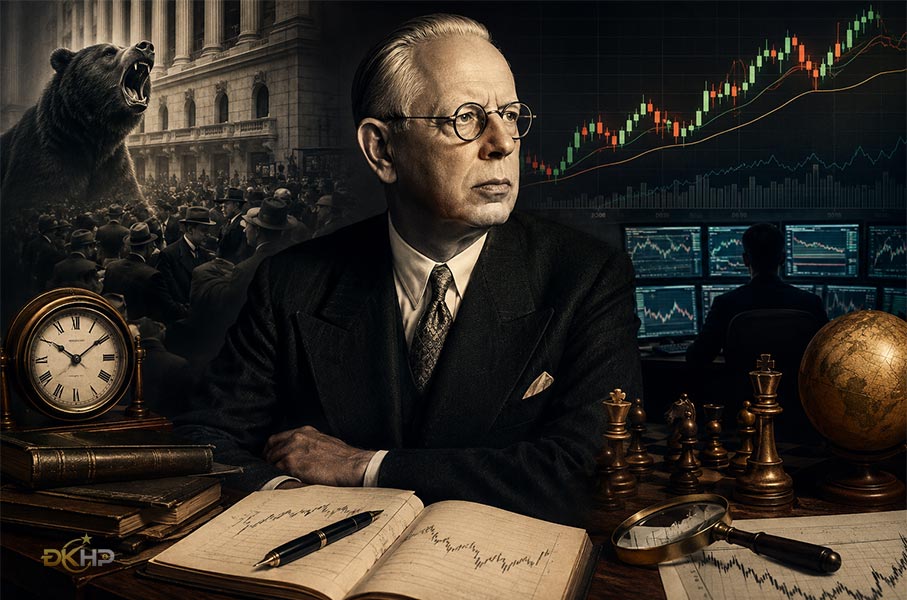
Jesse Livermore (1877–1940) was one of the most famous traders in the history of financial markets. He earned the nickname “The Great Bear of Wall Street” thanks to his ability to generate enormous profits during major stock market crashes, particularly during the Panic of 1907 and the Wall Street Crash of 1929.
Although he lived more than a century ago, Jesse Livermore’s trading principles remain the foundation of many modern trading approaches, including Trend Following, Swing Trading, Position Trading, and Breakout Trading.
1. Trend Is Your Friend
This is perhaps Jesse Livermore’s most famous trading philosophy.
He believed:
Never try to predict the market. Observe it and trade in the direction it is moving.
Livermore noticed that most traders lose money because they constantly try to pick tops and bottoms. They believe they are smarter than the market.
In reality, the biggest profits are usually made by traders who align themselves with the primary trend.
Example
If Bitcoin is in a strong uptrend:
- Avoid constantly looking for short-selling opportunities.
- Focus on finding buying opportunities that follow the trend.
If the market is experiencing a sharp decline:
- Avoid trying to catch the bottom too early.
- Wait for a clear reversal signal or continue trading with the downtrend.
Modern Applications
This philosophy forms the foundation of:
- Trend Following
- Position Trading
- Swing Trading
- EMA Trading
- Moving Average Trading
2. Only Trade When a Clear Opportunity Exists
Livermore once said:
Money is not made by trading all the time. It is made by waiting.
This is one of the most difficult concepts for modern traders to accept.
Many people feel they must place trades every day in order to be considered active traders.
However, Livermore believed:
- Opportunities do not exist all the time.
- Sometimes the best action is no action at all.
- Trades should only be taken when the probability of success is genuinely high.
Common Mistakes
- Entering trades out of boredom.
- Overtrading.
- Jumping into the market simply because it is moving.
Modern Applications
This principle is widely used in:
- Breakout Trading
- Price Action Trading
- Smart Money Concept (SMC)
- Supply and Demand Trading
Professional traders typically execute trades only when all conditions in their trading plan are met.
3. Cut Losses Quickly and Let Profits Run
One of Jesse Livermore’s most important principles was:
Small losses are a cost of doing business. Large losses are a disaster.
Livermore always cut his losses immediately when the market proved him wrong.
He understood that:
- No one is right 100% of the time.
- Being wrong is normal.
- The key is to lose little when wrong and make a lot when right.
The Profit Formula
A trader can have:
- A 40% win rate
- A 60% loss rate
And still make a significant amount of money if:
- Each losing trade equals -1R
- Each winning trade equals +3R or +5R
Modern Applications
This principle lies at the heart of:
- Risk Management
- Trend Following
- Swing Trading
- Position Trading
Many of the world’s top investment funds continue to follow similar principles today.
4. Big Money Is Not Made in the Entry, but in the Holding
This philosophy played a major role in building Jesse Livermore’s legendary reputation.
He once said:
It was never my thinking that made the big money. It was always my sitting.
Many traders constantly search for:
- The perfect entry point
- A magical indicator
- An extremely accurate signal
However, Livermore realized that:
A major trend can last for weeks, months, or even years.
The biggest profits come from holding a position throughout that trend.
Example
Suppose you buy Bitcoin at:
- $20,000
- Sell at $22,000
Your profit is 10%.
But if you hold until:
- $40,000
- $60,000
- $80,000
The outcome becomes dramatically different.
Modern Applications
This principle is the core of:
- Position Trading
- Trend Following
- Turtle Trading
Many legendary investors built the majority of their wealth from only a handful of exceptional trades throughout their careers.
5. Never Average Down on a Losing Position
Jesse Livermore strongly opposed averaging down.
He believed:
Never increase a position when the market is proving you wrong.
For example:
- Buy BTC at $100,000
- Price falls to $90,000
Many traders continue buying because they believe the asset has become cheaper.
Livermore viewed this behavior as extremely dangerous.
If the original analysis was correct:
- The market will eventually move as expected.
- There is no need to “rescue” the trade.
If the analysis was wrong:
- Cut the loss.
- Do not commit more capital to a losing idea.
Modern Applications
This principle is widely followed by:
- Trend Following Traders
- CTA Funds
- Hedge Funds
- Proprietary Trading Firms
Most professional traders only add to positions that are already profitable.
How Would Jesse Livermore Trade in Today’s Crypto Market?
If Jesse Livermore were alive and trading Bitcoin, Ethereum, or Forex today, he would most likely:
Look for Breakouts
- Price breaks through major resistance levels.
- Trading volume increases significantly.
- The trend is confirmed.
Trade with the Trend
- Buy only in an uptrend.
- Sell only in a downtrend.
Cut Losses Quickly
- No hope.
- No praying for the market to reverse.
Hold Winning Positions
- Allow profits to grow as much as possible.
- Avoid taking profits too early.
Never Average Down
- Add to positions only when they are already profitable.
Conclusion
Although today’s markets have changed dramatically with the rise of Forex, cryptocurrencies, and algorithmic trading, Jesse Livermore’s core principles remain as relevant as ever.
His five most famous trading philosophies are:
- Trend is your friend.
- Only trade when a clear opportunity exists.
- Cut losses quickly and let profits run.
- Big money is made by holding, not by entering.
- Never average down on a losing position.
If Jesse Livermore’s entire trading philosophy could be summarized in one sentence, it would be:
Follow the trend, manage risk strictly, and patiently hold winning trades long enough to give profits the opportunity to grow.